RO Plant for Hospital in Delhi NCR: Why Every Healthcare Facility Needs One in 2026
20 Jul, 2026
ISO 9001:2015
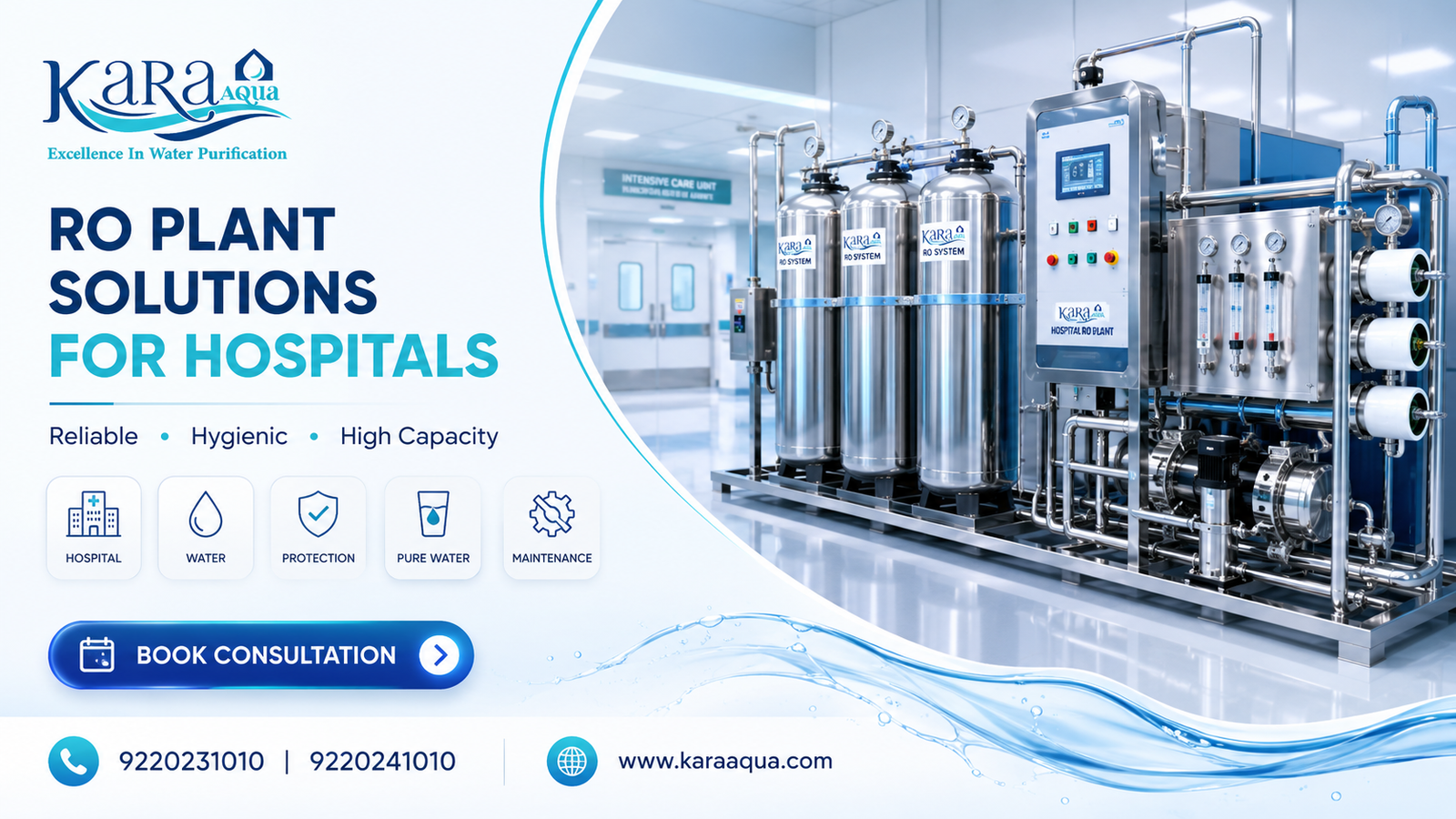
In the bustling hospitals of Delhi NCR, where every second counts for saving lives, one critical element often gets overlooked until problems arise: water quality. As a water treatment expert with over 10+ years of hands-on experience installing and maintaining RO plants for hospitals, I’ve seen how contaminated or inconsistent water can lead to equipment failures, infections, and even regulatory non-compliance.
At Kara Aqua, we’ve helped numerous healthcare facilities in Delhi, Noida, Ghaziabad, and surrounding areas switch to reliable RO Plant for Hospital in Delhi NCR systems. These aren’t just purification units — they are lifelines that deliver medical-grade water for dialysis, surgical scrubs, ICU humidifiers, laboratory tests, and patient drinking water.
If your hospital is struggling with high TDS borewell water, frequent scaling in autoclaves, or concerns about bacterial contamination, this guide shares real-world insights, actionable steps, and lessons from actual installations. We focus on practical solutions that deliver results, not generic theory.
Delhi NCR’s water sources — a mix of municipal supply and groundwater — often carry TDS levels of 400-900+ mg/L, along with heavy metals, pesticides, and microbial risks due to urban pollution and over-extraction. Standard municipal treatment falls short for clinical use.
Hospitals require water that meets stringent standards like BIS IS 10500 and, for dialysis, even stricter AAMI/ISO guidelines for low endotoxin and bacterial counts. Without a proper Medical RO Plant in Delhi, risks include:
Real Case Example: In 2023, a mid-sized kidney hospital in East Delhi approached us with recurring dialysis machine alarms and patient complaints about water taste. Their existing setup was undersized and poorly maintained. After installing a customized 500 LPH RO system with UV and proper storage, rejection rates stabilized, and machine downtime dropped by over 70% within the first month. Patients noticed the difference immediately.
A well-designed hospital RO plant serves multiple critical functions:
Kidney Hospital RO Plant / Dialysis Water: Dialysis demands ultra-pure water (conductivity <10 µS/cm, low bacteria). Our systems include double-pass RO or polishing stages for safety.
For a typical 100-300 bed hospital in Delhi NCR, a 500 LPH RO Plant for Hospital often proves ideal as a starting point, scalable with storage tanks and distribution loops.
Capacity selection is crucial. Undersizing leads to shortages during peak hours; oversizing wastes energy and capital.
500 LPH RO Plant for Hospital advantages:
Selection Checklist:
We always recommend a free site survey — something we’ve done for hundreds of clients. One lesson from experience: Many hospitals initially opt for cheap local units that fail within 1-2 years due to poor membranes and inadequate pretreatment.
From our installations at Kara Aqua:
Multi-Stage Filtration: Sand/carbon pre-filters, antiscalant dosing, high-pressure pump, RO membranes (Filmtec or equivalent), UV disinfection, and optional UF/post-polishing.
Affordable Hospital RO Plant options from us balance quality and cost, with transparent pricing and AMC packages that keep long-term expenses predictable.
Over 10 years, I’ve witnessed these pitfalls:
Ignoring Pretreatment: High iron or turbidity clogs membranes quickly. Always install proper multimedia filters and softeners if needed.
Lesson Learned: In one kidney hospital project, we retrofitted a failing system. By adding proper pretreatment and a monthly maintenance protocol, membrane life extended from 1 year to 3+ years, saving significant costs.
RO Plant Maintenance for Hospitals is non-negotiable for compliance and safety. Our AMC clients follow this proven schedule:
Daily Checks:
Weekly/Monthly:
Quarterly/As Needed:
Pro Tip: Log everything. Trends in pressure drop or TDS creep signal issues early. We provide digital logging support for our clients.
For Industrial RO Plant for Hospital Delhi, schedule CIP every 3-6 months depending on feed water quality. Consistent maintenance reduces energy use by 15-20% and extends system life to 10-15 years.
Our process at Kara Aqua:
Free site survey and water testing.
We serve areas like Laxmi Nagar, Preet Vihar, Noida, and beyond with quick response teams.
Initial investment for a quality 500 LPH RO Plant for Hospital in Delhi NCR varies but pays back through reduced equipment repairs, lower infection risks, and eliminated bottled water costs. Expect savings on boiler descaling and dialysis membrane replacements alone.
We offer flexible options including rental/AMCs for budget-conscious facilities.
With 10+ years of real projects, 1000+ installations, and a focus on healthcare, we deliver systems that work in Delhi’s challenging water conditions. Our team ensures compliance, reliability, and peace of mind.
Explore our services:
Conclusion: Take Action for Safer Hospital Water Today
A proper RO Plant for Hospital in Delhi NCR is an investment in patient safety, operational efficiency, and regulatory compliance. From avoiding common mistakes to implementing robust maintenance, the right system transforms water from a liability into a strength.
Don’t wait for a crisis. Schedule a free water audit and consultation with our experts. We’ll assess your needs and recommend a tailored, reliable solution that delivers results — just as we have for many healthcare clients across NCR.
Contact Kara Aqua today for reliable RO installation, maintenance, and support. Your patients and staff deserve the best.
Q. Why does a hospital need a dedicated RO Plant in Delhi NCR?
A hospital requires a specialized RO Plant because regular drinking water is not pure enough for medical use. RO systems remove bacteria, viruses, heavy metals, and dissolved salts to provide safe water for dialysis, surgical procedures, ICU, laboratories, and patient drinking water. This helps prevent infections and protects expensive medical equipment.
Q. What is the ideal capacity of RO Plant for hospital in Delhi NCR?
For small to medium hospitals, a 500 LPH RO Plant is usually ideal. Larger multi-specialty hospitals may need 1000–2000 LPH or more. The right capacity depends on the number of beds, dialysis units, daily water consumption, and future expansion plans. We always recommend a free water audit before deciding.
Q. What is the cost of a RO Plant for Hospital in Delhi NCR?
The cost of a good quality 500 LPH hospital RO Plant typically ranges from ₹2.5 lakh to ₹5 lakh (depending on automation, materials, and features). Larger systems cost more. This includes installation. We also offer affordable AMC packages to keep running costs low.
Q. How long does it take to install an RO Plant in a hospital?
A 500 LPH RO Plant installation usually takes 2 to 5 working days, depending on site conditions and civil work requirements. We plan the installation to cause minimum disruption to hospital operations.
Q. Is RO water safe for dialysis and kidney patients?
Yes. A properly designed Kidney Hospital RO Plant with double-pass RO, UV, and polishing filters produces medical-grade water that meets AAMI and BIS standards. It ensures very low TDS, bacteria, and endotoxin levels, which is critical for patient safety during dialysis.
Q. What are the main challenges of running an RO Plant in Delhi NCR?
High TDS, iron, and fluctuating raw water quality are common issues. Proper pretreatment, regular maintenance, and quality components are necessary to avoid frequent membrane choking and system failure.
Written by Ashish Kumar, Founder of Kara Aqua, with 10+ years of experience in commercial and medical RO plants in Delhi NCR.
There are many variations of passages of Lorem Ipsum available, but the majority have suffered alteration in some form by injected randomised words which don't look even slightly believable.
There are many variations of passages of Lorem Ipsum available, but the majority have suffered alteration in some form.
No FAQs available at the moment.
